

Housing is a basic right that Finland has agreed to secure through international agreements. In March 2026, the European Education and Culture Executive Agency (EACEA) published a comparative YouthWiki report on Youth Access to Affordable and Quality Housing (Visit an external site. The link opens in a new tab.). The principles of affordability and quality are linked to international human rights agreements, which is why it is relevant to examine European countries’ policy measures from these perspectives.
The report reveals the multiplicity of national-level practices addressing youth housing, as well as possible shortcomings in securing this basic right. This blog post aims to shed light on the background of the report and asks: do we have a joint language to discuss young people’s affordable housing?
The publication Youth access to affordable and quality housing. A comparative analysis of national policies (Visit an external site. The link opens in a new tab.) aims to give an overview of the situation of young people’s affordable and quality housing in Europe. This comparative analysis examines how young people’s housing is supported in 34 European countries.
YouthWiki correspondents participated in gathering information about policy measures at the national level. YouthWiki is Europe’s comprehensive online database describing the structures, policies, and actions of national youth policies within 34 European countries. The database is open access, and it aims to support European-level cooperation and evidence-based decision-making. In Finland, YouthWiki is updated as part of the Finnish Youth Research Society’s YouthWiki project.
The EU’s limited competence in housing policy
The comparative report shows that young people’s housing is supported through varying policy actions. As stated in the Youth Research Society’s previous news release, published on 7 April 2026, there are also shortcomings in the participating countries’ current policy actions. For example, these actions do not always consider young migrants’ needs, differences in challenges between rural and urban areas, and young people’s own views in policymaking processes.
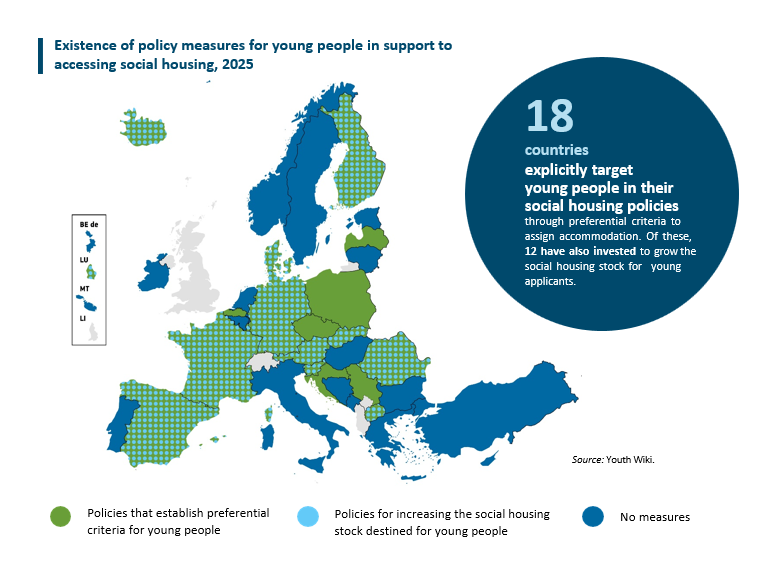
Nonetheless, differences between national-level policies are expected. Housing (as well as youth) policy falls within the competence of EU member states. The European Union may provide support and funding, but it does not have direct competence in the area of housing policy. In Finland, Environment and Climate Minister Sari Multala has also underlined (Visit an external site. The link opens in a new tab.) that housing policy is a national competence.
However, the establishment of the Housing Special Committee, the EU’s decision to appoint its first Energy and Housing Commissioner, and the European Affordable Housing Plan, published in December 2025, indicate that housing policy is becoming increasingly central in the EU’s policymaking (see also Sutela, 2026, pp. 97–99). The current Energy and Housing Commissioner Dan Jørgensen has emphasised (Visit an external site. The link opens in a new tab.) that housing should be recognised as a basic right. Thus, the YouthWiki report is connected to broader EU-level policy actions and contributes to providing a platform to discuss the principles of housing policy.
Quality and affordability are linked to housing as a basic right
Housing has been recognised as a basic right in Article 25 of the Universal Declaration of Human Rights (UDHR), Article 11 of the International Covenant on Economic, Social and Cultural Rights (ICESCR), as well as Principle 19 of the European Pillar of Social Rights. Principle 19 especially addresses social housing and the right to housing assistance (see Housing Crisis in the European Union (Visit an external site. The link opens in a new tab.), 2026). The right to housing is also enshrined in the Constitution of Finland (Section 19)
Finland has developed and supported a rights-based approach to housing policy, for example, by implementing the Housing First principle, which was first developed in the United States (Kettunen, 2013). The report, in turn, draws attention to Finland’s current Programme to Eradicate Homelessness by 2030, which recognises young people as a target group. The report also showcases that the Housing First principle has been adopted to support youth housing in particular, for example, in Denmark (see p. 40).
The principle of affordability, meanwhile, can be derived from General Comment number 4 to the ICESCR (section 8). It states that the financial costs of housing should not threaten or compromise the attainment of other basic needs. The General Comment also includes clarification regarding the location, accessibility, and habitability of housing, which are closely linked to questions about housing quality. Finland is one of the countries that have ratified the ICESCR.
Young people and concern over housing affordability
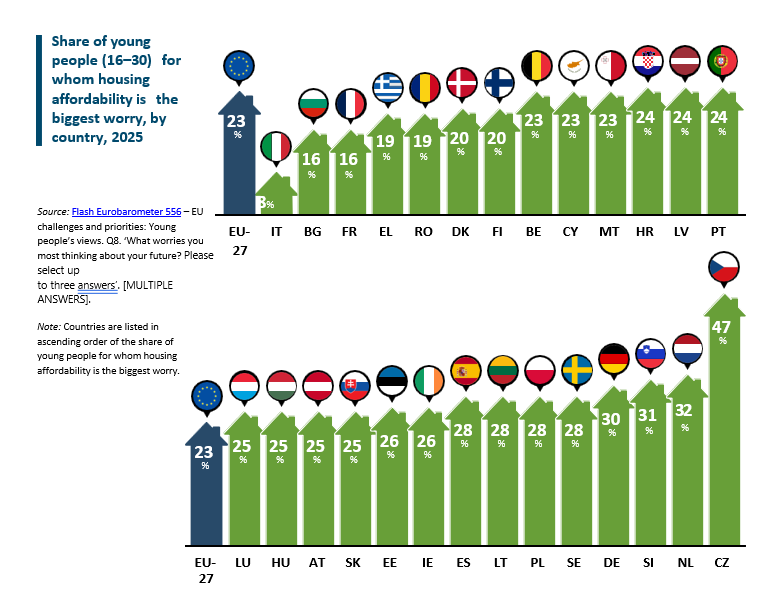
The report states that 20 per cent of Finnish young people feel that housing affordability is their biggest concern. This is slightly below the EU average (23 per cent). Every fifth young person in Finland is significantly concerned about affordable housing. One can compare these results to previous research at the national and international level. The Ministry of the Environment’s Young People and Housing 2025 (Visit an external site. The link opens in a new tab.) survey reveals that four out of five Finnish young people are content with their housing situation. At the same time, 37 per cent stated that their income does not adequately cover their housing costs. The Centre for State-Subsidised Housing Construction’s (Varke) Homeless People 2025 (Visit an external site. The link opens in a new tab.) report shows that, in percentage terms, the homelessness of under-25-year-olds has grown the most. In the Young People and Housing 2025 survey, a quarter of young people assessed that changes to social security benefits have increased housing costs as an economic burden.
The challenges of affordable housing in Finland are concentrated in the rental sector, which is in line with other European countries (Sutela, 2026, p. 67; see also Hick et al., 2024). Up to 81 per cent of young people in Finland live in rental apartments. The 2022 OECD report No Home for the Young? Stylised Facts and Policy Challenges (Visit an external site. The link opens in a new tab.) states that, together with those in Ireland and Greece, young Finnish people aged 20–29 are more likely to live in rental housing compared with the general population.
Academic research on young people’s homelessness has shed light on the long-term consequences of housing challenges experienced during youth. Mayock’s (2023) study, conducted in Ireland, focuses on how homelessness impacts the identity formation of young people and their experiences of ontological security. Interviews carried out during the longitudinal study reveal that gaining access to housing shaped young people’s identity and improved their self-confidence, as well as their experience of agency. These objectives have also shaped the Finnish Housing First policy. However, the concept of affordability, which the YouthWiki report also highlights, has received critique in Finnish academic discussion for its unclear definition (see Sutela, 2026).
Ambiguity of affordability
Elina Sutela’s dissertation, The Vexed Question of Urban Housing Affordability – Definitions, Measurement and Policy in Finland, published on 6 June 2026, criticises the unclear definition of the concept of “affordability” (kohtuuhintaisuus, in Finnish) in Finland. Sutela identifies three approaches to affordability and suggests that the normative approach is the best for examining affordability, as it allows one to examine housing in connection with the broader frameworks of poverty and the welfare state. In the normative approach, affordability is often measured by how incomes and expenses compare. EU-level monitoring tools, such as the EU-SILC, also examine affordability from this perspective. Housing costs are viewed as a significant burden when they exceed 40 per cent of a person’s income (Sutela, 2026, pp. 8, 41). Lastly, Sutela argues that housing is not adequately recognised as a basic need (Sutela, 2026, pp. 5, 89–94).
The challenge of defining affordable housing and affordability is not a new observation. The Ministry of the Environment published the report Housing Policy in Europe – What Can We Learn? (Visit an external site. The link opens in a new tab.) in 2020 (in Finnish), which underlines that housing affordability and the indicators used to measure it should be examined in more detail in Finland (pp. 9, 49). Currently, homelessness rates remain relatively low in Finland. According to the Homeless People 2025 report, 17 per cent of homeless people living alone were under-25-year-olds. However, one may ask: can the unclear definition of the concept of “affordability” itself hinder the discussion of support for young people’s housing in Finland, as well as internationally? The Affordable Housing Act (Visit an external site. The link opens in a new tab.), which is currently under preparation in the EU, indicates that affordability will continue to be a central element of the EU’s actions within housing policy.
Author
Solja Kumpula has worked as Finland’s correspondent for the YouthWiki project between 2025-2026, together with Anu Gretschel.
References
Cournède, B. and M. Plouin (2022), No Home for the Young?: Stylised Facts and Policy Challenges, OECD Publishing, Paris.
European Parliament (n.d.) Housing crisis in the European Union. Fact Sheets on the European Union. https://www.europarl.europa.eu/factsheets/en/sheet/353487/asuntokriisi-euroopan-unionissa (Visit an external site. The link opens in a new tab.)
Hernándes-Morales, A. (16 joulukuuta 2025). EU unveils first-ever plan to combat housing crisis, rein in short-term rentals. Politico.
Kettunen, M. (2013). Asunto ensin – malli Yhdysvalloista ja soveltaminen Suomessa (in Finnish). Yhteiskuntapolitiikka.
Mayock, P. (2023). (Re)assembling the Self: Homeless Young People’s Identity Journeys and the Search for Ontological Security. Child Care in Practice, 29(3), 297–318.
Ministry of the Environment (17 December 2025). Euroopan komissiolta ehdotus kohtuuhintaisen ja kestävän asumisen kehittämisestä (in Finnish). https://valtioneuvosto.fi/-/1410903/euroopan-komissiolta-ehdotus-kohtuuhintaisen-ja-kestavan-asumisen-kehittamisesta?languageId=fi_FI (Visit an external site. The link opens in a new tab.).
Ronkainen, T. & Kuhno, R. (3. June, 2026). Young people and housing 2025 (Nuorten asuminen 2025 Kyselytutkimus, in Finnish). Publications of the Ministry of the Environment 2026:25, Helsinki 2026. ISBN pdf: 978-952-361-071-2
Ruonavaara, H., Kettunen, H., Sutela, E., Tyvelä, H. (December 2020). Housing policy in Europe What can we learn? (Asuntopolitiikkaa Euroopassa – Mitä voimme oppia?, in Finnish). Publications of the Ministry of the Environment 2020:30.
Sutela, E. (2026). The Vexed question of urban housing affordability: Definitions, measurement and policy in Finland. Academic dissertation, University of Turku.
Centre for State-Subsidised Housing Construction (28 January, 2026). Homeless people 2025. Publications of the Centre for State-Subsidised Housing Construction 2026:3.
United Nations (n.d.) The human right to adequate housing. Special Rapporteur on the right to adequate housing. https://www.ohchr.org/en/special-procedures/sr-housing/human-right-adequate-housing (Visit an external site. The link opens in a new tab.).
Featured image: Valery Fedotov / Unsplash.